01
Find Your Business Intersection
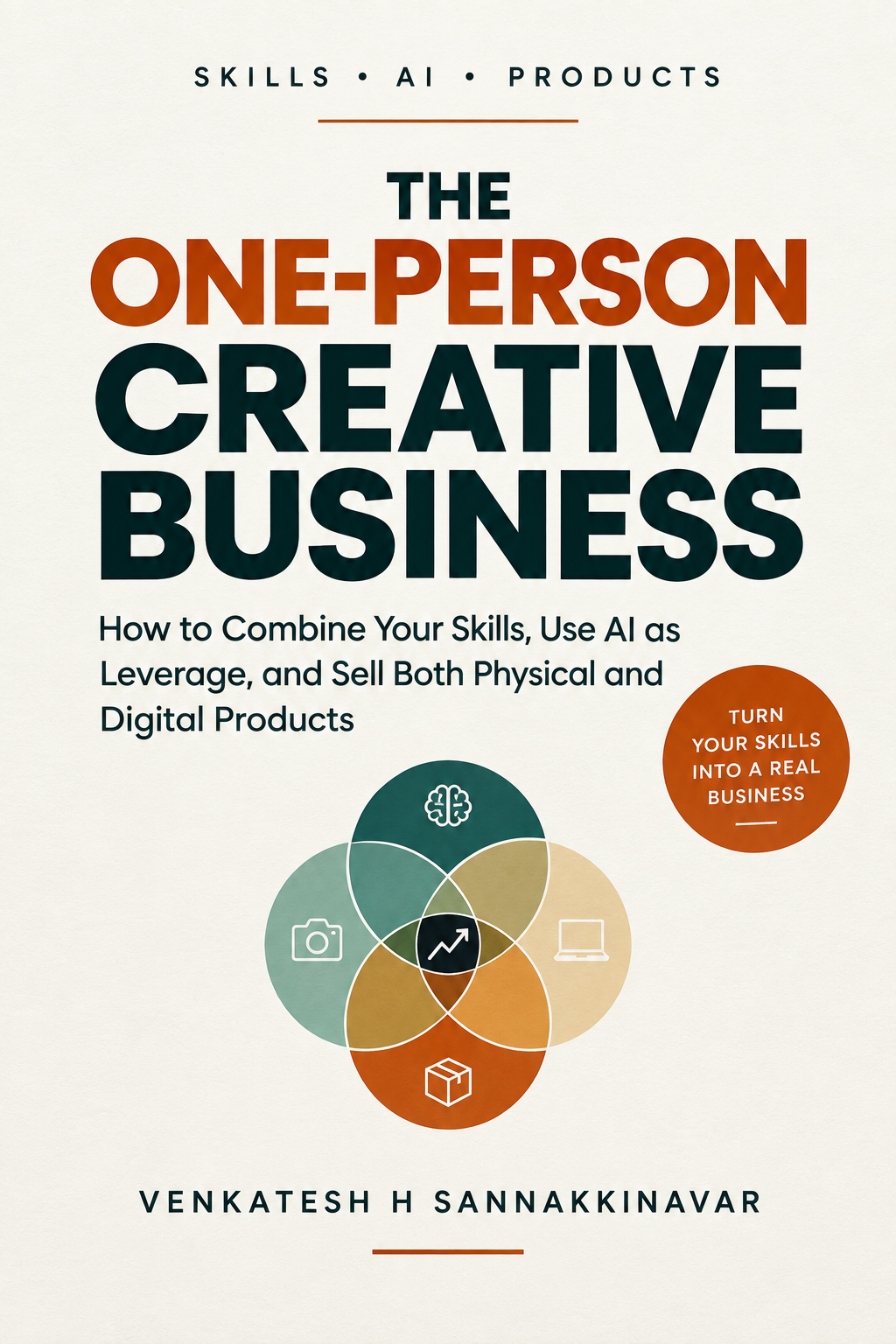
Locate the point where your skills, the market and your interests overlap — and stop competing on the axis where you are weakest.
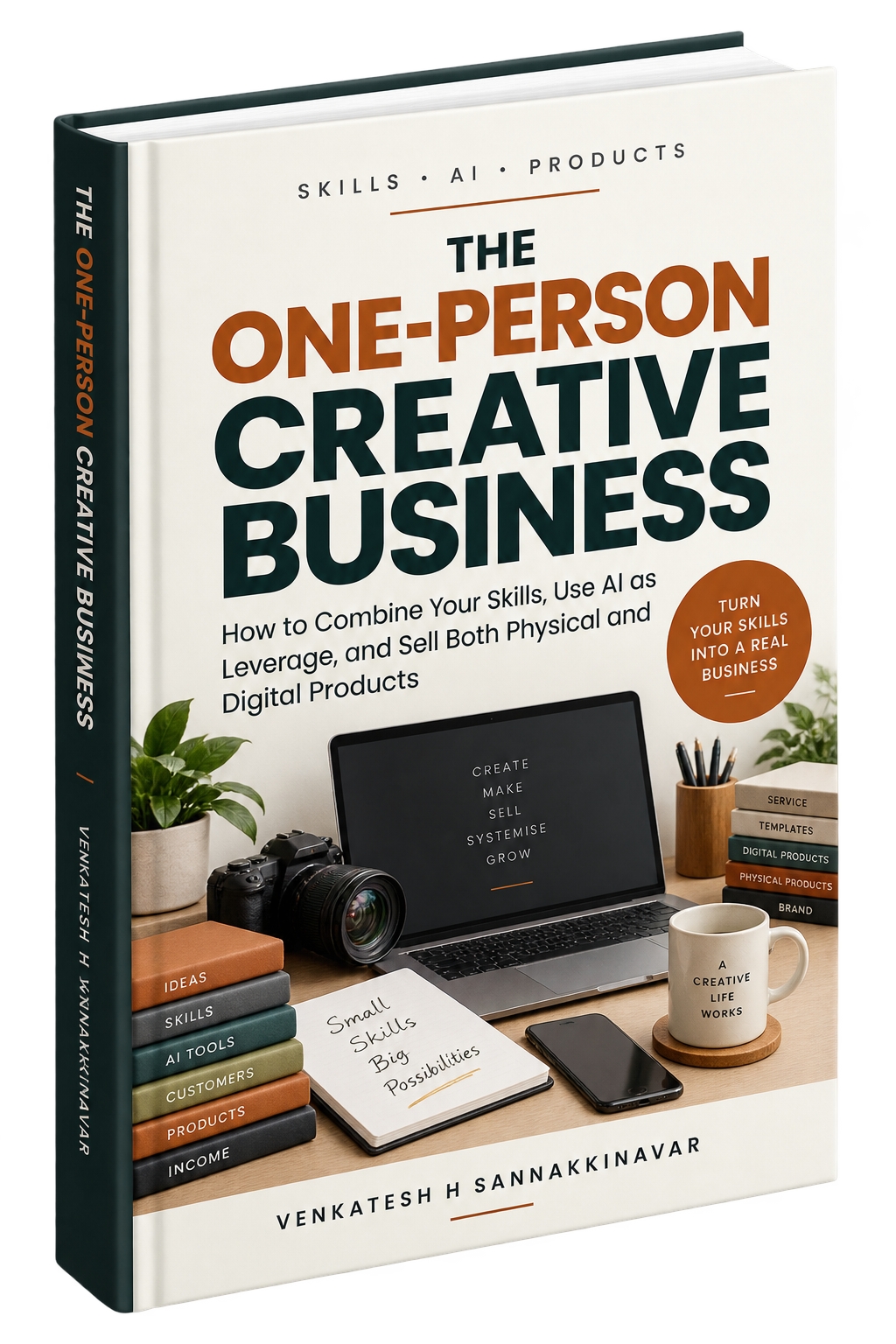
You don't need a big team, a perfect plan, or another dozen tools. You need a way to combine what you already know, use AI as leverage, and turn your skills into things people can actually buy.
Practical frameworks, exercises and systems for building a one-person creative business.
You know how to create. You know how to do the work. You may even have several useful skills that rarely appear in the same person. What you don't have is the conversion — the part nobody showed you.
This book is designed to help you connect the pieces.
Locate the point where your skills, the market and your interests overlap — and stop competing on the axis where you are weakest.
Move from "I can do this" to a written offer with a defined scope and a boundary someone can say yes to.
Service, productised service, template, digital product, physical product or bundle — chosen on purpose, not by accident.
Test demand with the smallest thing you can put in front of a real buyer, before you spend three months making it.
Build an AI-assisted creative team around role, input, output and the human checkpoint — tool-agnostic, so it survives the next release.
The mechanics of packaging a capability into something with a price, a delivery method and a repeatable production path.
Price from actual cost and value rather than from what feels safe, and know where your floor is.
Marketing when nobody knows you: proof produced as a by-product of the work you are already doing.
Turn work you have done three times into an SOP, with checkpoints placed before the irreversible moments.
What changes when you go from doing everything to running something — and what nobody tells you about working alone.
Alone, the person who is excellent at one thing and helpless at everything else is not a specialist — they are a bottleneck. Two or three ordinary skills that rarely appear together, pointed at the same customer, are a structural advantage.
You do not need six months of planning before your first customer. Start, test, learn, repeat — then systematise what actually works. One paid job teaches more than three months of preparation.
The same capability can become a service, a productised service, a template, a digital product, a physical product, a bundle, a brand. The book teaches you how to run your own skill through that progression.
Seventeen chapters on the unglamorous mechanics of turning what you can already do into something people pay for — repeatedly, without a team, an investor or a following.
Thirteen exercises. Each one produces something you keep — a written artifact, not a feeling of clarity. By the end you should be holding a skill inventory, a stack sentence, a named customer, a written offer with a scope boundary, a defensible price, a contact list, a documented process, and a plan with dates on it.
Each one exists to make a specific exercise faster.
A one-page roadmap running the twelve weeks of Exercise 13, with the checkpoints marked. The single most useful page to keep visible.
One capability laid out across the forms it can take — service, productised service, template, digital product, physical product, bundle. A blank grid plus a worked example.
Grouped by the capital they require, from almost none to substantial. Not ideas to copy; ideas to study for how the combination was made and how it was priced.
Written tool-agnostically as role → input → output → human checkpoint, so they remain usable as the tools change. Each one names where judgment stays with you.
Each produces proof as a by-product of work you are doing anyway. Demonstrations, before-and-afters, decisions explained, common mistakes.
One page. Priced, scoped, boundary written, first customer contacted, proof captured, advance agreed. A go or no-go test before you ship.
A blank one-page template — name, frequency, steps, decision points, checkpoints — plus one completed example so you can see what finished looks like.
Organised by conversation stage: before they know you exist, when they are interested, and when they are deciding. Designed for listening rather than pitching.
People who already have useful skills but no structured business around them — designers, photographers, content creators, video editors, writers, printers, engravers, handmade product makers, freelancers, consultants, and skilled employees who want to build something independently.
No. The book is written for the point before there is a business — when there are skills, some scattered ideas, and no system. If you already run something, Parts IV and V will be the most immediately useful.
No. Part III treats AI as leverage rather than as a subject. The workflows are written tool-agnostically as role → input → output → human checkpoint, so they stay usable as the tools change.
No. The examples come from printing, laser engraving, manufacturing, photography, media production and event work as much as from design.
Yes. Chapter 11 and the Conversion Map deal specifically with turning a capability into something physical — production path, cost, packaging, delivery.
Yes. Templates, productised services and digital products are treated as different points on the same progression as a service, and priced differently.
Practical. Seventeen chapters make the argument, then thirteen exercises make you produce written artifacts — an inventory, a stack sentence, a named customer, a priced offer, an SOP and a 90-day plan.
A PDF and an EPUB, including the full workbook and the eight bonus resources.
Immediately after successful payment you are redirected to a thank-you page with a download button. The link is also available if you return to that page.
Payment is handled by an external payment gateway. On success you are redirected to the thank-you page for this book and the download is unlocked.
You don't need to have everything figured out. You need a clear way to start.
GET THIS EBOOK — ₹199Secure payment • Instant access after successful payment